
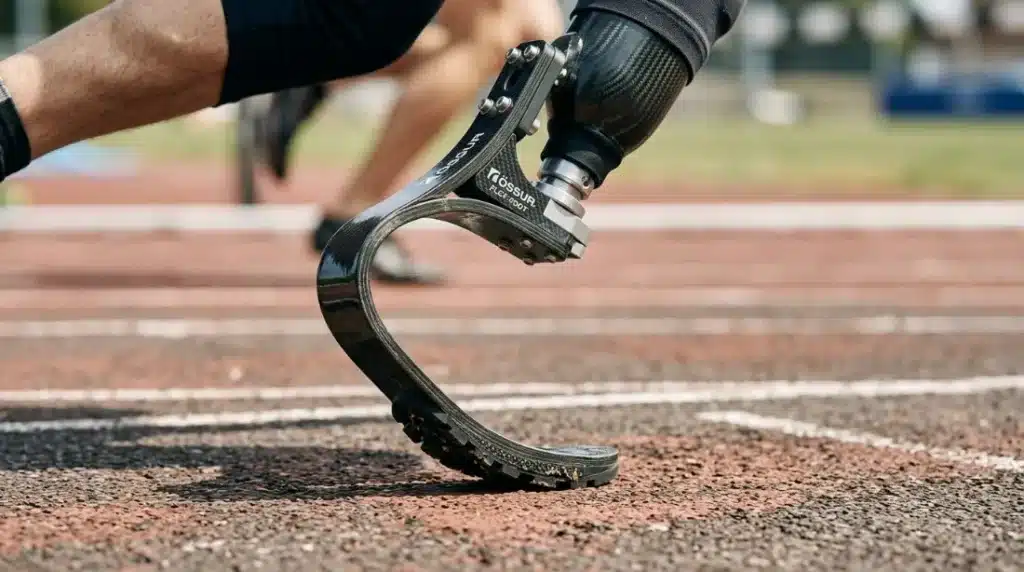
From simple SACH feet to high-tech microprocessor systems — everything you need to know to choose the right prosthetic foot for your body and your life in the UAE.
our prosthetic foot is the foundation of everything you do. It touches the ground with every step. It absorbs shock. It pushes you forward. Get it right, and walking feels natural again. Get it wrong, and you’re fighting your own prosthesis every single day.
This guide covers every type of prosthetic foot available today — what they do, who they’re built for, what they cost in the UAE, and how to make the right choice for your body and your lifestyle.
A prosthetic foot is the part of an artificial leg that touches the ground. It replaces your natural foot and ankle after amputation. There are four main types: basic SACH feet, single-axis feet, dynamic-response feet, and microprocessor-controlled feet. The right one depends on how active you are and what your daily life looks like.
A prosthetic foot is the lowest part of an artificial leg. It connects to the rest of the prosthesis and makes contact with the ground every time you take a step. But it does far more than just act as a base.
A prosthetic foot controls how your body rolls forward with each step. It absorbs shock when you land. It gives you a push-off when you move ahead. A bad foot makes walking harder. A good one makes it feel almost natural again.
Every prosthetic foot has to handle the same forces your natural foot would — compression, rotation, side-to-side movement, and push-off. How well a foot handles these forces depends on its design and materials.
Not every foot works for every person. A foot built for a slow, careful walker will feel stiff and limiting to an active person. A high-performance carbon-fibre foot designed for running will feel unstable and tiring for someone who walks short distances at home.
Getting your prosthetic foot wrong causes real problems — skin breakdown on the residual limb, back and hip pain from poor alignment, falls from instability, and fatigue from working too hard to walk. Getting it right means you walk with less effort, more confidence, and less pain.
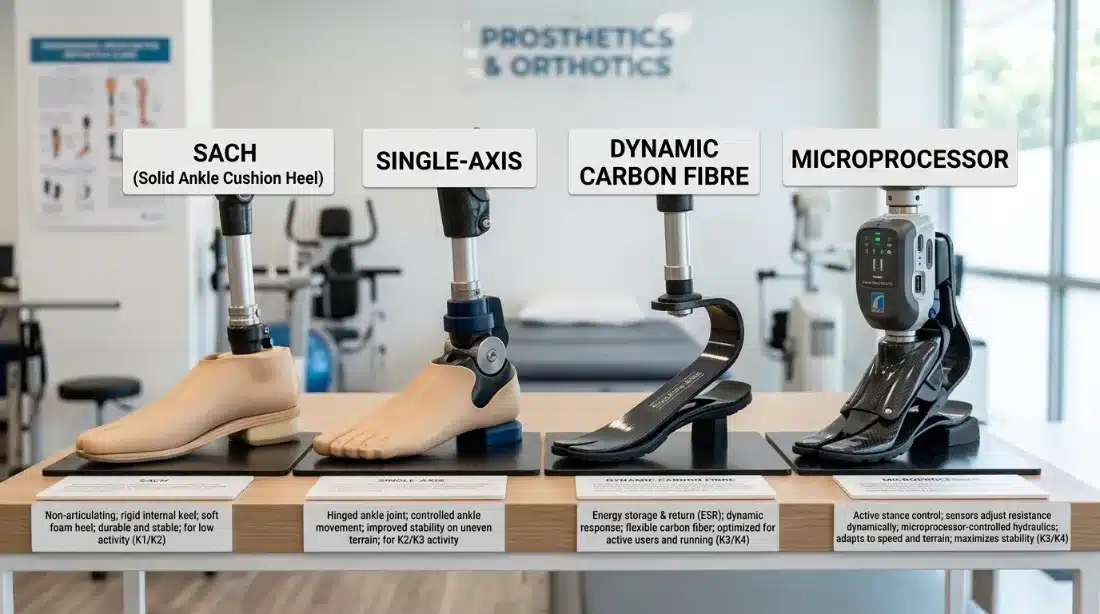
SACH stands for Solid Ankle Cushion Heel. These are the simplest prosthetic feet available. They have no moving parts. The heel is made of soft foam that compresses when you step down, mimicking the small movement your real heel makes at ground contact.
Best for: People who walk short distances at home or on flat, controlled surfaces. Also used as a starter foot during early rehabilitation.
Durable, low-cost, easy to maintain, works in most shoes
No ankle movement, no energy return, not for uneven ground
These feet have a mechanical hinge at the ankle that lets the foot move up and down slightly as you walk. This small movement helps your knee stay stable during the first part of your step — the moment your heel hits the ground.
Best for: Above-knee amputees who need extra knee stability, or anyone walking on gentle slopes.
Improved stability, better on sloped surfaces, safer for certain amputees
Heavier, limited side-to-side flexibility, still no energy return
Made from carbon fibre that bends under pressure and springs back. When you step down, the foot stores energy. When you push off, it releases that energy back into your step — like a bouncing board. The result? Walking feels more natural and you use less effort.
Best for: Active users who walk varied distances, want a natural gait, or are returning to work or sport.
Energy return, lighter weight, natural push-off, better on uneven ground
Higher cost, may wear faster with very high activity
The most advanced option available. Onboard computers and sensors adjust to your movements in real time — hundreds of times per second. Step onto a slope, the foot adjusts. Walk faster, it responds. Step sideways, it compensates. Some models connect to a smartphone app for mode switching.
Best for: High-activity users, people on varied terrain, and anyone who wants the closest experience to a natural foot.
Real-time adaptation, improved safety, smoother gait, mode switching
Most expensive, requires charging, needs annual servicing

The material affects weight, durability, flexibility, and cost. Here is how the most common materials compare:
| Material | Weight | Flexibility | Durability | Best Use |
|---|---|---|---|---|
| Rubber & Foam | Heavy | Low | High | Basic / SACH feet |
| Aluminium | Medium | Low | High | Structural pylons |
| Carbon Fibre | Very light | High | Medium–High | Dynamic / high-performance feet |
| Titanium | Light | Low | Very High | Structural components |
| Composite Blends | Varies | Medium | High | Mid-range dynamic feet |
Carbon fibre is the gold standard for active users. It gives the best combination of strength, lightness, and energy return.
The right prosthetic foot is not the most expensive one — it is the one that matches your body, your goals, and your daily life.
Prosthetists use the K-level system to match each person to the right foot. Here is what each level means and which foot type fits best.
Your K-level is not permanent. As you build strength through rehabilitation, your level can improve — and your foot prescription can be updated to match.

Beyond the four main types, there are specialised feet built for specific needs and environments.
Costs depend heavily on the type and technology involved. Here is a realistic guide to what you should expect to budget:
These figures are for the foot component only. The full prosthetic system — including socket, pylon, and liner — adds to the total. Many UAE residents have prosthetic coverage through health insurance or employer benefit schemes. Always check your policy before paying out of pocket.
A well-maintained prosthetic foot lasts longer, performs better, and is safer. Follow these six steps every week:
Most carbon-fibre feet need replacing every 3–5 years, depending on activity level and body weight.

A cheaper foot for a K3 walker is not a bargain — it is a mismatch that causes fatigue, pain, and injury over time.
Prosthetic feet are calibrated for a specific heel height. Switching between flat shoes and heels throws off your alignment. Plan for the footwear you actually wear daily.
Your residual limb changes after amputation. A foot that fits well at month one may be poorly aligned by month six. Follow-up is not optional.
Tell your prosthetist everything — your job, hobbies, and how much you travel. A foot prescription built on incomplete information rarely fits real life.
Sand and dust in the UAE get into joints and connections fast. A foot that is not cleaned regularly wears out sooner and may fail without warning.
Use this checklist when you sit down with your prosthetist. Honest answers here lead to a far better outcome.
Most prosthetic feet last 3–5 years with regular use. High-activity users may replace a carbon-fibre foot every 2–3 years. Foam covers wear faster and often need replacing every 12–18 months. Your prosthetist will check for wear during routine appointments.
Most prosthetic feet work with a range of flat or low-heel shoes. But the foot is calibrated for a specific heel height. If you change heel height significantly, you need an alignment adjustment. Some feet have adjustable heel heights built in, giving you more flexibility.
Standard feet are water-resistant, not fully waterproof. Brief contact with water is fine, but submerging a standard foot can damage internal components. If you swim or spend a lot of time near water, ask about a dedicated waterproof foot — a popular choice for many UAE users.
For most community walkers (K3 level), yes. Studies show that carbon-fibre dynamic feet reduce energy use by up to 20% compared to basic feet, and users report walking longer distances with less fatigue. For limited walkers (K1), a basic foot may serve just as well.
No. Children need paediatric feet sized and weighted for their body. These are designed to be replaced frequently as children grow. A child’s prosthetic needs are very different from an adult’s, and a paediatric-trained prosthetist should always be involved.
Do not walk on a broken foot. It will throw off your alignment and can cause falls or injury to your residual limb. Contact your prosthetist immediately. Most clinics can arrange emergency or priority repairs. Keep your prosthetist’s contact number saved on your phone.
Some active users have two feet — one for daily use and one for sport. Running blades are not suitable for everyday walking. If you want to jog and also walk the office floor, your prosthetist may recommend a second activity-specific foot. Insurance coverage for multiple feet varies by policy.
Many UAE health insurance policies cover prosthetic components partially or fully when prescribed for medically necessary reasons. Coverage limits vary widely. Review your policy carefully or ask your prosthetist to help you with the documentation and pre-authorisation process.
StepsCreators provides prescription-based prosthetic services across the UAE and the wider GCC — clinical assessment, custom fabrication, fitting, and long-term support for every patient.